On this page
What Can Be Repaired on a Kansas City Deck?
Repair is the right approach when the damage is limited to specific parts and the structure around it is sound. Surface problems involve the decking, its fasteners, stair treads and railing infill. Structural problems involve the parts that carry the load: joists, beams, posts, footings, stair stringers and the metal connectors that tie them together. Both can usually be repaired, but a structural repair has to restore the part's ability to carry weight, not just its appearance.
Fixing Loose, Split and Soft Deck Boards
Wood swells and shrinks as its moisture content changes, and that movement works smooth nails up out of the joists. Driving them back down rarely lasts, because the same movement lifts them again. The better fix is to pull the nails and refasten the boards with exterior-rated deck screws driven into the joists, or with the fastening system the decking was designed for.
Boards that are split, cupped or decayed are replaced individually. Before a new board goes down, we check the top of the joist beneath it. Water that collects between a board and a joist can decay the joist before the board above it fails, and rot around the screw holes is often the first sign. A joist that is soft only at the surface is assessed for how deep the decay runs before it's left in place, so the new board isn't fastened to wood that won't hold it.
When boards are failing across most of the deck rather than in one area, replacing them one at a time stops being practical. New decking over the whole deck on a sound frame is a resurfacing job.
Repairing Joists, Beams and Hangers on a Kansas City Deck
A joist with localized decay is usually repaired by sistering, which means fastening a new full-depth joist alongside the damaged one. For the new joist to carry the load, it runs from support to support rather than only past the bad section, and it's fastened to sound wood. When decay has gone through the joist or reached the ends where it bears on a beam or hanger, the joist is replaced instead, which means removing the decking above it. Beams are handled the same way, and a repaired beam needs any splice to land over a post, a point NADRA's checklist calls out specifically.
Joist hangers are the metal brackets that carry the end of each joist. NADRA's checklist flags several hanger and connector problems that call for replacement:
- Bent or modified hangers
- steel bent in the field can fracture at the bend, and fractured steel won't carry its load
- The wrong fasteners
- short nails where the hanger requires full-length ones, or slotted and Phillips-head screws, which the checklist says have never been appropriate for connectors
- Red rust
- corrosion on hangers, fasteners or connectors anywhere in the frame
Corrosion has a specific cause on many decks. The preservatives in treated lumber corrode steel faster than untreated wood does, so hardware installed without enough protection can rust from the contact alone. The American Wood Council's deck construction guide calls for hot-dip galvanized or stainless steel hardware with treated wood, and Overland Park's deck guidelines call for galvanized, stainless or specially coated fasteners with ACQ-treated lumber. Replacement hangers and fasteners are matched to that standard, with the joist supported while the old hardware comes off.
How Rotted Deck Posts and Footings Are Repaired
Posts decay fastest at the base. NADRA's checklist notes that decay may appear just below the point where the post meets the ground or concrete, so a post can look solid above grade while its base has softened. Posts buried in soil or set directly in concrete are the most vulnerable, because the material around them holds moisture against the wood. The top of a post can fail too, especially where it was notched to hold a beam.
Repairing a decayed post starts with supporting the deck temporarily so the load comes off it. The damaged post is removed, or cut back to sound wood where enough remains, and the new or shortened post is set on a metal post base that holds its end above the concrete. NADRA's checklist points to base hardware with a raised standoff plate for exactly this reason: it keeps the end grain out of standing water and helps prevent the decay from starting again.
A post that has sunk or leaned usually means a footing problem rather than a post problem. A footing that has settled, or that sits above the frost depth your city enforces, can keep moving as the ground freezes and thaws. Shimming the boards above a low corner hides that movement without stopping it, so the lasting repair is new support at that point.
Repairing Loose Railings and Stairs in Kansas City
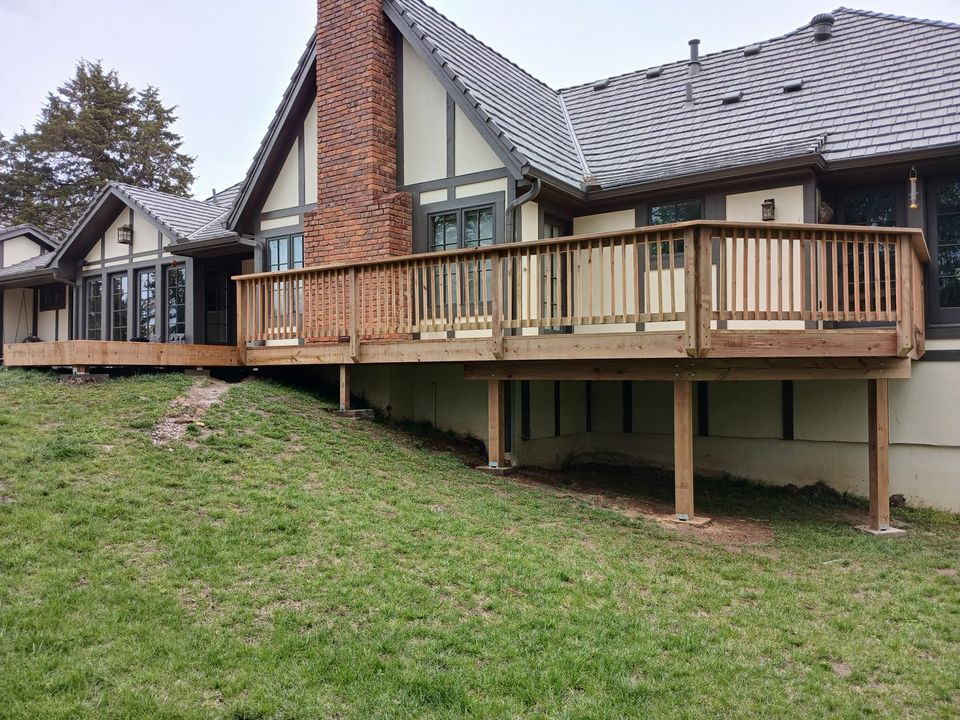
A railing that moves when you lean on it usually has a problem at the post, not the rail. NADRA's checklist notes that posts held to the rim joist with bolts or lag screws alone, and posts notched to sit flush with the frame, failed to meet the load and deflection criteria guards are tested against. Tightening the existing bolts can stiffen the post for a while, but the wood around them compresses and the movement returns. A lasting repair rebuilds the connection with blocking and hold-down hardware that ties the post back into the joists, so the load goes into the frame instead of the edge of one board. Decayed rails and balusters are replaced to match. Code requirements for guards and the choice of railing systems are covered on our deck railing page.
Stairs fail at both ends. At the bottom, stringers decay where they rest on soil or on concrete that stays wet. The repair supports the stairs, cuts back or replaces the damaged stringers, and sets them on a solid surface that drains, with hardware that holds them in place. At the top, NADRA's checklist calls the connection between the stringers and the deck a critical structural connection and flags stringers held by nails alone. Re-attaching them with proper hangers or hardware corrects that connection. Treads that are split or soft can be replaced on sound stringers. When a staircase needs new geometry rather than new parts, that work belongs with deck stair installation.
What Makes a Deck Repair Worth Doing?
A repair is worth doing when the damage is local, the frame around it is sound, the deck's connection to the house is solid, and fixing the cause will stop the problem from coming back. A soft board over a sound joist, a railing post with a weak connection and a stair stringer decayed at its base all fit that description.
The case changes when decay runs through many joists, when footings are failing in several places, when the ledger at the house is decayed, nailed on or missing its flashing, or when repairs keep moving to new parts of the deck. Those are the signs that the structure itself has reached the end of its service life, and our deck replacement page explains how that decision is made.
The cost to fix a deck depends on what failed and how far the damage reaches. The main factors are:
- What's damaged
- replacing a few boards is a much smaller job than sistering joists, resetting posts or rebuilding a stair
- Hidden decay
- damage found once boards come up adds to the scope
- Access
- a high deck, or one with little room underneath, takes more time and support to work on safely
- Hardware
- corroded connectors often need replacing across a section, not at a single joist
- Material availability
- matching boards or railing parts can limit the choices
- Permits
- where structural work requires one, its fees and inspections are part of the job
Get a deck repair estimate
Deck Repair Questions
Do I need a permit to repair my deck?
It depends on the city and the work. Overland Park's deck guidelines state that repairs to the walking surface, guardrails or handrails don't require a permit, while building or replacing a deck does. Kansas City, Missouri lets ordinary repairs proceed without a permit, but its code excludes work that removes or cuts any structural beam or load-bearing support from that definition, so structural repairs can fall outside it. Requirements in other cities are covered on our service area pages.
Will new boards match the rest of my deck?
Not right away. New pressure-treated lumber starts out a different color from boards that have weathered, and cedar grays as it ages. Composite colors fade over time, so even the same product line can look different. Sound older boards can be moved into the most visible spots with the new ones placed where they're seen less, and on a wood deck, cleaning and refinishing the whole surface evens out the color. Care for wood decks is covered on our wood deck page.
How should I compare deck repair contractors?
Compare what each estimate covers rather than the total alone. A complete repair estimate names the parts being repaired and the parts being left as they are, says whether the joists under replaced boards will be checked, specifies the fasteners and connectors to be used, describes how railing posts will be reattached, and explains how damage found after the boards come up will be handled. Two estimates that differ on those points are describing different repairs.