
On this page
Choosing Composite Decking in Kansas City: Capped, Uncapped or PVC?
"Composite" is used loosely for any manufactured decking, but the boards sold today fall into three groups that behave differently outdoors.
Uncapped composite is the earlier generation: a blend of plastic and wood fiber with that blend exposed at the surface. Because the wood fiber is exposed, these boards are more prone to absorbing moisture, staining and fading. Boards that contain wood can also show tannin bleeding, a temporary discoloration from natural wood extractives that weathers away with rain and sunlight.
Capped composite has a similar core, made of plastic and organic material such as wood flour, wrapped in a protective polymer shell. Depending on the product line, the cap covers three or four sides of the board. The cap is the surface you walk on and clean, and it's what gives the board its resistance to staining, fading and moisture.
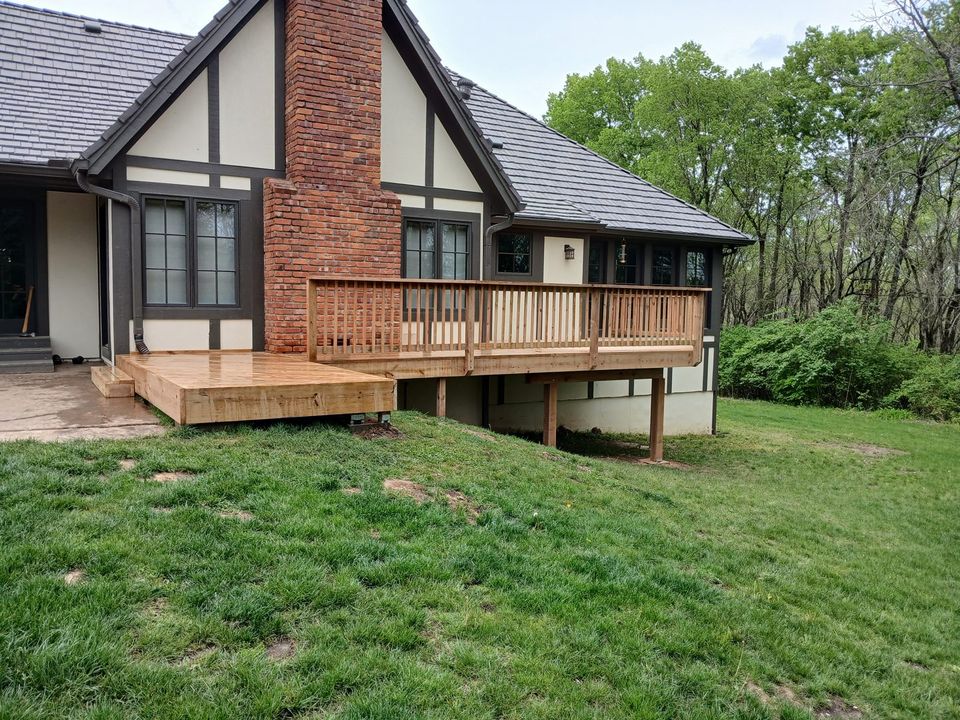
Composite vs Wood: What Changes With Composite Boards
The main difference is upkeep. Composite and PVC boards aren't stained or sealed. Their care is cleaning: manufacturers' care guides call for rinsing the surface with a hose and washing it with warm, soapy water and a soft-bristle brush. Pollen, dirt and leaves left on the boards give mildew something to feed on, so regular rinsing matters even when the deck looks clean. Food and grease spills come off most easily when they're fresh. Some manufacturers allow pressure washing only below a set pressure and with a fan tip held back from the surface, and rubber-backed mats can discolor some boards.
What doesn't change is the frame. Composite boards can't be used as structural material, so the posts, beams and joists underneath are conventional framing, typically pressure-treated lumber. That framing still needs to shed water, which is why manufacturers recommend protective tape over the tops of the joists to keep water out of fastener holes and the top of the wood.
Composite costs more up front than pressure-treated wood. The wood side of the comparison, including species and how wood decks are maintained, is covered on our wood deck construction page.
How Hot and Slippery Do Composite Boards Get?
Heat is the most common complaint about composite. Manufacturers state plainly that all decking gets hot in direct sun and that the darker the color, the hotter it feels, and Trex's installation guide advises a lighter color in hotter climates. Some PVC lines are sold with heat-reducing technology in select colors, while standard composite is rated average for heat resistance in the same manufacturer comparison cited above.
Reflected sunlight is a separate problem. Both major manufacturers warn that low-emissivity (Low-E) window glass can reflect and concentrate sunlight onto decking, with results that range from discoloration and warping to melting of the surface. For locations near glass or other areas of high heat build-up, TimberTech's installation guide calls for added framing with joists 6 to 8 inches apart and top-down fastening. Where a deck sits beside large windows, we account for that during design.
Composite boards have an embossed surface for grip, but manufacturers note they can become slippery in winter weather like any walking surface. Their care guides permit calcium chloride ice melt, which can leave a white residue that rinses off, and recommend a plastic shovel, since metal shovels or plastic shovels with a metal edge can damage the surface.
How We Install a Composite Deck in Kansas City
The International Residential Code requires plastic composite deck boards, stair treads, guards and handrails to be installed in accordance with the code and the manufacturer's instructions. The installation guide for the chosen board is therefore part of what the deck has to meet, and the main requirements are consistent across manufacturers:
- Joist spacing
- standard composite boards laid perpendicular to the joists generally require joists no more than 16 inches on center, and boards laid diagonally require 12 inches on center under Trex's and TimberTech's guides. The Johnson County deck guideline notes the same 16-inch spacing for composite.
- Flat, even joists
- composite follows the frame beneath it, so joists are checked for level and plane, with high spots planed and low spots shimmed before the decking goes on.
- Blocking
- picture-frame borders, breaker boards and joints where board ends meet need extra framing underneath, so every board end is supported and fastened.
- Fasteners
- grooved-edge boards are held with hidden clips that also set the gap between boards, leaving a surface without screw heads. Perimeter and square-edged boards are face-fastened with screws made for the product.
- Gapping
- boards are spaced side to side for drainage, and the gaps at board ends and against the house are set by the temperature at installation, because composite expands and contracts as temperatures change.
- Ventilation and drainage
- TimberTech's guide says decking shouldn't be installed where ventilation and airflow can't be achieved, requires at least a 1½-inch sleeper system where airflow is obstructed, such as on-grade installations, and calls for drainage provisions beneath on-grade decks.
Because each product line has its own spans and gaps, the frame is designed for the specific board before construction starts. On a new deck, that decision is made during design, so joist spacing, blocking for borders and the deck's height above grade all suit the decking from the start.
Code Labeling for Composite Boards: ASTM D7032
ASTM D7032 is the standard used to establish performance ratings for wood-plastic composite and plastic lumber deck boards, stair treads, guards and handrails. Under the International Residential Code, compliant boards or their packaging carry a label showing compliance with the standard, along with the board's allowable load and maximum allowable span. The code also sets a flame spread limit for these products and requires boards that contain wood or other organic material to be decay resistant.
Overland Park's Guidelines for Residential Decks, revised July 2026, require all plastic and plastic composite materials, meaning any decking that isn't 100% wood, to be labeled and listed to comply with ASTM D7032, referencing Section R507.2 of the 2024 International Residential Code. Composite handrails carry the same requirement. In practice, the labeled span is the limit the frame has to meet, which is why the joist spacing follows the product rather than a general rule. Other cities in the metro adopt their own code editions, which our service area pages cover.
What Drives the Cost of a Composite Deck in Kansas City
The decking itself is only one part of the cost. The main factors are:
- Board category and collection
- uncapped composite, capped composite and PVC differ in price, and so do collections within each category.
- Framing
- a new frame at 16- or 12-inch spacing, or added joists to bring an existing frame within the board's limit.
- Layout
- diagonal boards, picture-frame borders and breaker boards need closer joists, more blocking and more cutting.
- Fasteners and trim
- hidden clips, product-specific screws and fascia boards that cover the rim joists and stair stringers.
- Railings and stairs
- railing systems vary widely, and every stair run adds treads, risers and framing.
- Height and site
- taller decks need more framing and guards, and low decks need the clearance and drainage the manufacturer requires.
A frame that already meets the board's spacing and passes inspection lowers the cost, which is why the frame is evaluated before the decking is priced.
Get a composite deck estimate
Composite Deck Installation Questions
Can composite go on my existing wood frame?
It can when the frame passes the same tests as new construction. Manufacturers require a sound substructure with no soft spots, splits or decay, joists that are level and in plane, fasteners free of corrosion and a secure attachment to the house or posts. Spacing is the most common problem, because frames built for thicker wood decking were sometimes spaced 24 inches apart, too wide for most composite. Joists can be added between the existing ones when the rest of the frame is solid. Our deck resurfacing page explains how a frame is evaluated for reuse.
Why does composite sometimes feel bouncy?
Bounce comes from the spacing of the joists under the boards. TimberTech's guide sets 16 inches on center as the maximum for standard boards and notes that 12 inches may be preferred for a more rigid feel, so a frame built at the limit meets the requirement but feels less stiff than a closer one. Bounce also appears when diagonal boards are installed over joists spaced for straight runs, or when a board doesn't span at least three joists, which Trex's guide requires.
Do composite boards fade or stain?
Capped boards resist fading and staining better than uncapped boards, because the cap shields the core from sun and moisture. They aren't immune. Grease left on the surface, mildew growing on built-up debris and dust from concrete, mortar or stucco can all mark the cap, and masonry dust in particular can react with the surface once it gets hot or wet. Colors can also shift somewhat over time, so a board replaced years later may not exactly match the boards around it.