Deck Railing Installation
Railings with posts bolted into the framing, built to the guard height and opening rules your city enforces.
View service : Deck Railing Installation
KC Deck Builds · Kansas City metro
Exterior structural carpentry on decks, porches and gazebos: framing, stairs, railings and repairs.
Railings with posts bolted into the framing, built to the guard height and opening rules your city enforces.
View service : Deck Railing InstallationDeck stairs and steps built to the width, rise, run and handrail dimensions your city's code sets.
View service : Deck Stair InstallationCarpentry on an outdoor structure is load-bearing work. The joists, posts, stringers and railing posts carry people's weight, so how each piece is sized and connected matters more than how it's trimmed.
Our carpentry is done outdoors: framing and repairing decks, building stairs and railings, and repairing gazebos and other outdoor structures. KC Deck Builds is a locally owned, licensed and insured deck builder serving the Kansas City metro.
Exterior structural carpentry covers the wood framing that holds up an outdoor structure and the parts people use directly. On a deck, that means the ledger, beams, joists, posts, decking, stairs and guards. On a porch or gazebo, it adds the posts, beams and rafters that carry a roof. Johnson County's contractor licensing program describes this kind of work in its wood framing license, whose scope names wood decks, exterior staircases and their guard rails along with framed walls, roof assemblies and sheathing.
Most carpentry requests on an existing structure fall into four services:
Stairs and railings are where carpentry and safety meet most directly. Both attach to the deck frame, so a new stair or railing is only as strong as the rim joist and joists it fastens to. That's why carpentry on either one starts by checking the framing at the connection points.
The word carpenter covers two kinds of work that call for different skills. Structural carpentry, sometimes called rough carpentry or framing, builds the parts that carry loads. Finish carpentry is the visible trim and woodwork, mostly inside the house: door and window casing, baseboards, crown molding, cabinets and built-ins. The two differ in almost every way that matters to a homeowner hiring for one of them:
Outdoor structures need mostly structural carpentry, with some exterior finish work such as fascia boards and stair treads. The services described on our site are exterior structural carpentry on decks, porches and gazebos. Interior trim, cabinetry and other indoor finish carpentry aren't among them.
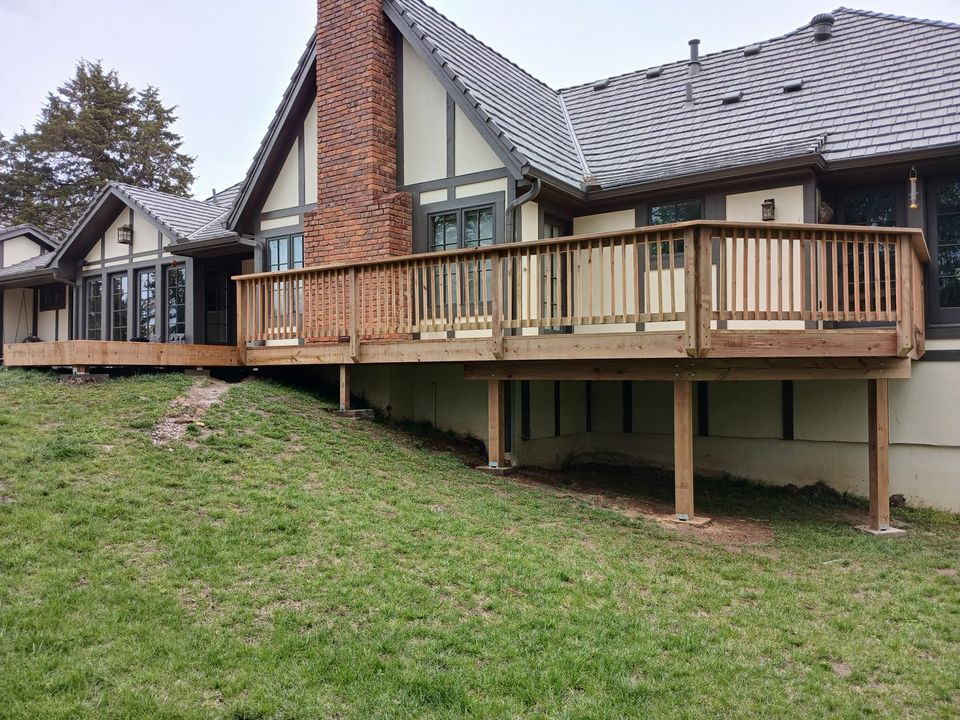
Every outdoor structure moves its load down a chain of members to the ground. On a deck, the decking bears on the joists, the joists on a beam or ledger, the beam on posts and the posts on footings. On a gazebo or covered porch, the roofing bears on the sheathing and rafters, which carry their load through beams and posts to the footings. A carpentry repair has to keep that chain continuous, which is why the connection matters as much as the new piece of wood.
That principle shapes how repairs are scoped. Adding a new board alongside a decayed joist doesn't help if the new board isn't supported at its ends. Replacing a rotted post means carrying the beam or roof above it on temporary supports while the old post comes out, then fastening the new one at the top and bottom with hardware rated for the load. Damage often turns out to be larger than it first looked, because decay spreads along the grain and hides under decking, behind fascia and at the base of posts. Opening the structure is often the only way to see how far it goes.
Where an outdoor structure meets the house, carpentry also involves the house's weather barrier. A deck ledger, a porch beam or a roof that ties into the wall sits where water can get behind the siding, so the flashing at that joint is part of the carpentry, not an afterthought. Our deck replacement page explains how that connection is built on a deck.
The cause is part of the repair. Wood decays where water stays in contact with it, so a post sitting in wet soil, a joist end under a failed flashing or a rafter below a roof leak will decay again unless the source of the water is corrected along with the wood.
Licensing decides who can do permitted carpentry in much of the metro. Overland Park requires an active Johnson County contractor's license of the proper type before it issues a building permit, and the county issues framing work under its general, building and residential classes as well as the wood framing class. A handyman without one of those licenses can't receive a permit in Overland Park for deck framing, a rebuilt stair or other permitted work.
Kansas City, Missouri organizes it differently. Its code allows building trades subcontractors who aren't otherwise required to be licensed to work under a licensed residential building contractor who holds a valid building permit, directed by that contractor's qualified supervisor. The license and the permit sit with the company running the job. On either side of the state line, the questions that decide a structural carpentry job are whether the work needs a permit in that city and whether the company doing it holds the license the city requires for it. Small repairs that don't need a permit fall outside those rules, while building or replacing a deck needs a permit in Overland Park, for example, and that permit has to be issued to a licensed contractor or to the homeowner.
On a house with details like these, new exterior carpentry looks best when it takes its proportions from what's already there. A new stair rail or deck railing can repeat the size of the existing posts, the spacing of the balusters or the shape of a newel cap. Stock components chosen without reference to the house usually look thinner and plainer beside original porch work. Matching proportions doesn't require copying ornament, and it doesn't change the structural requirements: a railing that echoes a historic balustrade still has to meet the guard rules your city enforces.
Get a carpentry estimate
A deck builder is a carpenter who specializes in one kind of structure. General carpenters work across framing, finish and repair, indoors and out. A deck specialist works with the details that only outdoor structures have, such as footings below the frost line, ledger flashing, guard post connections and decking that has to be spaced and fastened to its manufacturer's instructions.
Yes. The repair starts by working out how the deck was built: its joist sizes and spacing, how it attaches to the house and what its posts and footings sit on. Some older decks were built to earlier rules, so a repair to one part can show that a connection nearby needs attention too.
Outdoor wood stays wet longer and sits closer to the ground. Overland Park's deck guidelines require treated wood in contact with the ground to be labeled for that use, and treated lumber needs corrosion-resistant fasteners and connectors. Our wood deck page explains which lumber goes where and how hardware is matched to it.
Get an estimate
Call or send a request for an estimate. Choose the service you need from the list below.
(913) 687-7031 ↗︎Prefer to talk it through? Give us a call.